




Demystifying SIFs: Unlocking Hedged, PMS-Style Strategies at ₹10 Lakh
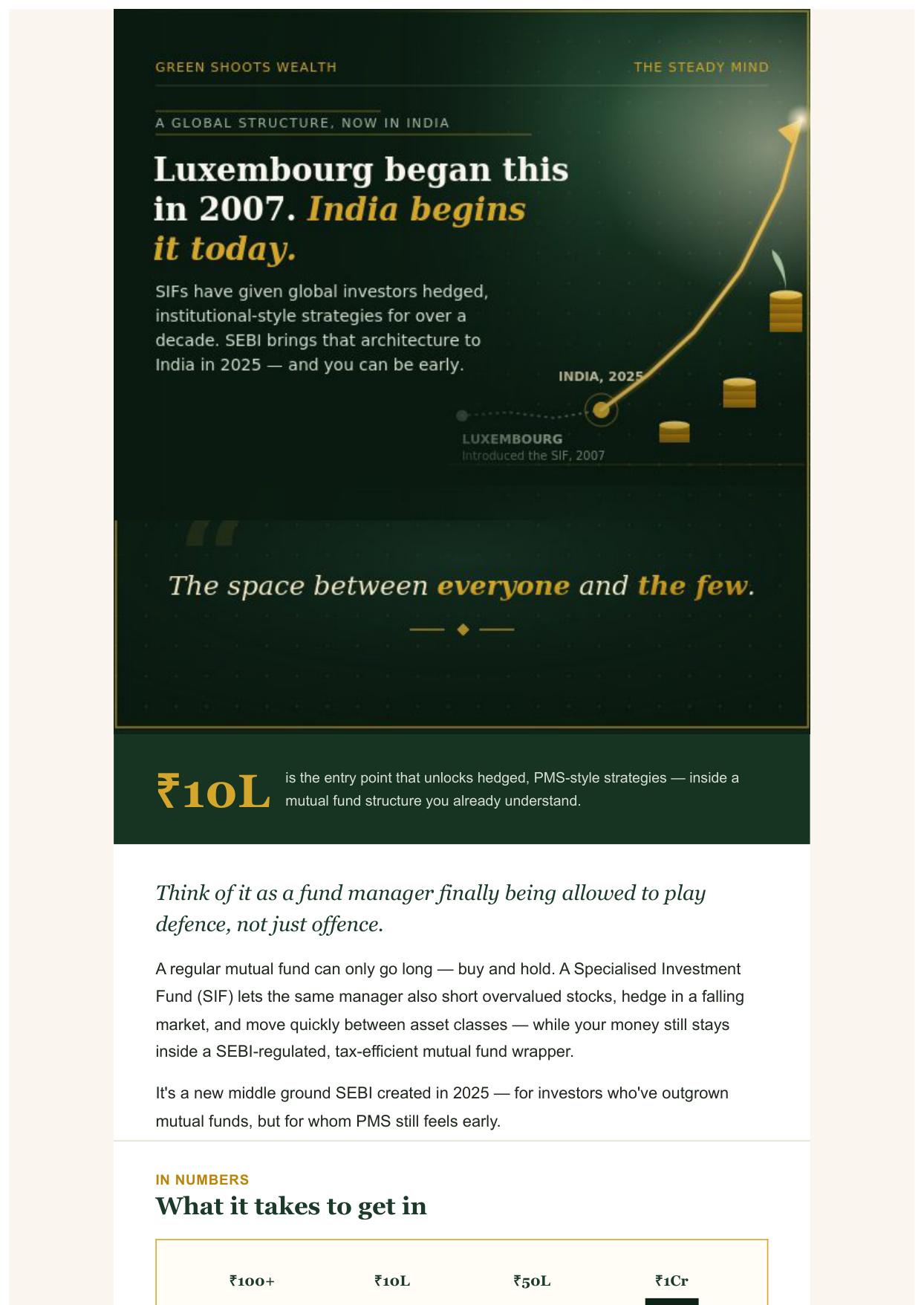
Think of it as a fund manager finally being allowed to play defence, not just offence.
Closes the massive ₹49.9 Lakh gap between mutual funds (₹100) and PMS (₹50 Lakh)
Managers can short overvalued stocks and hedge with derivatives during market drawdowns
Operates inside a mutual fund tax wrapper with daily NAV pricing and transparency
Ideal for investors who have outgrown plain vanilla mutual funds but aren't ready for ₹50L PMS
Core Findings & Strategic Context
A regular mutual fund can only go long—buy and hold. If the market plunges 20%, the fund manager is legally compelled to ride the entire drop down with you. Specialised Investment Funds (SIFs), a groundbreaking category formally sanctioned by SEBI in 2025, unlock hedged, PMS-style long-short flexibility at an accessible ₹10 Lakh ticket size while preserving mutual fund tax efficiency. This guide breaks down how SIFs operate, their risk-return trade-offs, and who should consider them.
✦ Key Takeaways for Wealth Builders
- •SIFs bridge the gap between Mutual Funds (₹500 min) and Portfolio Management Services (₹50 Lakh min) at an accessible ₹10 Lakh threshold.
- •Unlike conventional mutual funds that are restricted to long-only mandates, SIF managers can deploy short positions and derivative hedges to protect capital in bear markets.
- •SIFs enjoy mutual fund tax rules, avoiding the complex individual security-level tax filings characteristic of PMS.
- •If redemptions cause an investor's balance to fall below ₹10 Lakh, SEBI mandates a 30-day cure window to top up, failing which units are redeemed by the AMC.
Report Sections & Detailed Data
What is a Specialised Investment Fund (SIF)?
The Middle Ground Between Mutual Funds and PMS
In traditional mutual funds, managers are fundamentally constrained to playing offence: they can only buy and hold equities. Even if they anticipate a severe market downturn, they cannot take tactical short positions or deploy comprehensive derivative hedges.
A Specialised Investment Fund (SIF) allows the fund manager to play defence. They can hold high-conviction compounders on the long side while actively shorting overvalued companies or indices to cushion against sharp drawdowns—all within a SEBI-regulated, daily-priced mutual fund structure.
| Vehicle | Minimum Ticket | Strategy Mandate | Tax Framework |
|---|---|---|---|
| Mutual Funds | ₹100 to ₹500 | Long-only buy and hold | Equity mutual fund capital gains rules |
| SIF (Specialised Fund) | ₹10 Lakh | Long-short, dynamic hedging, multi-asset | Favourable mutual fund tax pass-through wrapper |
| PMS (Portfolio Mgmt) | ₹50 Lakh | Discretionary concentrated equities | Individual security-level capital gains per trade |
| AIF (Alternative Fund) | ₹1 Crore | Private equity, long-short, unlisted debt | Complex trust/pass-through tax rules (Cat I/II/III) |
Three Primary SIF Strategy Archetypes
How Fund Managers Deploy Capital
1. Equity Long-Short: Holds superior companies with strong cash flows while systematically shorting structurally flawed or overvalued stocks to generate alpha while limiting net market exposure.
2. Hybrid Long-Short: Blends high-grade fixed income with hedged equity, smoothing out volatility and targeting consistent risk-adjusted returns across market cycles.
3. Active Tactical Asset Allocator: Shifts dynamically between domestic equities, fixed income, sovereign gold, and REITs as macroeconomic valuations fluctuate.
The Honest Picture: Benefits vs. Watch-outs
Evaluating Downside Protection vs. Costs
The Advantages: Significantly lower ticket size than PMS/AIF, genuine downside hedging, daily NAV liquidity, and strict SEBI regulatory disclosures.
The Limitations: Active hedging can cause SIFs to lag runaway bull markets where high-beta equities surge unchecked; expense ratios are higher than plain vanilla index funds; and the ₹10 Lakh principal requirement must be maintained long-term.
Read the Original Document
Evaluate Whether SIF Strategies Fit Your Portfolio
Our advisory team analyzes your portfolio risk appetite to determine if hedged strategies provide optimal capital preservation.
Explore Other Publications
Your First ₹1 Crore: Three Stories, One Number
Three different paths – a fixed SIP, a step-up SIP and a lumpsum – each can grow to ₹1 crore over 20 years.
The Bonus Retired, Diwali Didn't
Investing ₹12,000 each Diwali in a diversified equity fund can grow to about ₹53 lakh over 40 years, yielding ₹3.2 lakh per year.
Who Will Power India's Next Decade?
Inside India's energy transformation — capacity, capital, and the companies building it.