




Who Will Power India's Next Decade?
Inside India's energy transformation — capacity, capital, and the companies building it.
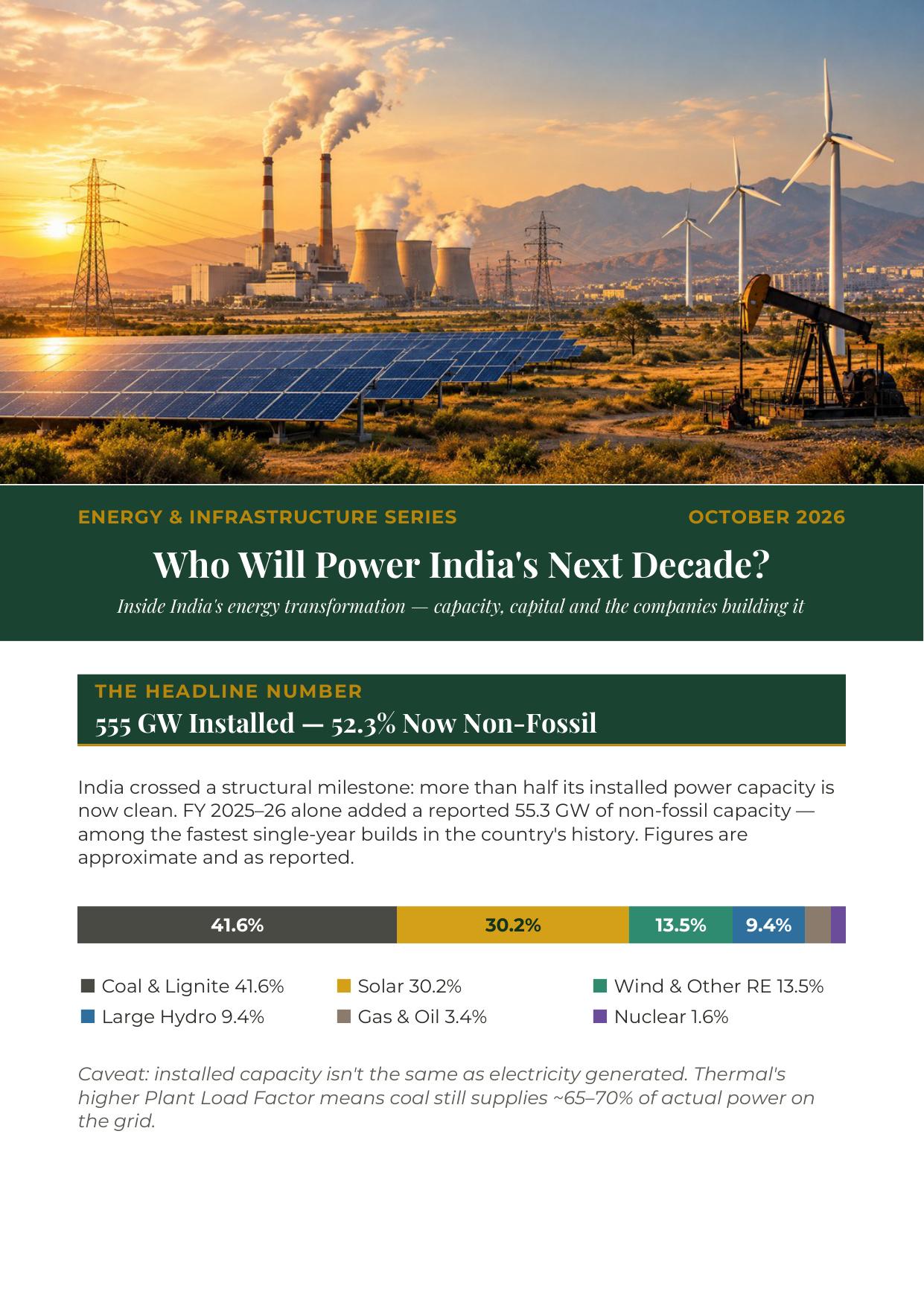
52.3% is now clean/non-fossil power
Solar capacity expanded from 8 GW (2016) to 168 GW (2026)
Requiring an estimated ₹33 Lakh Crore in capital expenditure
Projected peak grid demand driven by EVs, data centres & PLI manufacturing
Core Findings & Strategic Context
India crossed a historic structural milestone in 2026: over half of its total installed power capacity is now non-fossil. Power utilities have transitioned from balance-sheet repair to structural growth compounders. This institutional report dissects the capacity expansion, critical mineral import dependencies, the ₹33 Lakh Crore financing gap, and the hybrid public-private dominance model steering the subcontinent's energy independence.
✦ Key Takeaways for Wealth Builders
- •Coal supplies 65–70% of actual generation due to high thermal PLF, even though non-fossil installed capacity has exceeded 52.3%.
- •Power Grid and NTPC have been structurally re-rated on steady dividend yields, green hydrogen diversification, and critical transmission monopolies.
- •The next constraint is not generation but grid transmission and critical mineral import reliance (Lithium, Polysilicon, Copper).
- •A ₹33 Lakh Crore financing gap through 2030 will rely heavily on public sector banks (~₹10 Lakh Cr pledged) combined with aggressive private infrastructure capital.
Report Sections & Detailed Data
A Decade of Compounding (2016–2026)
From Balance Sheet Repair to Structural Growth Compounders
A decade ago, power utilities were trapped in the UDAY scheme era—weighed down by discom debt, stressed balance sheets, and stalled power purchase agreements (PPAs). Between 2016 and 2026, total installed capacity surged from ~300 GW to ~555 GW.
During this cycle, Adani Green and Adani Power saw 10–20x market cap expansion, NTPC and Power Grid experienced 3–4x re-ratings on record dividends and green hydrogen ventures, and Tata Power re-engineered itself from a legacy thermal producer into an integrated green mobility and rooftop solar ecosystem.
Where India Stands Globally
IRENA Renewable Output vs. Installed Capacity Benchmarks
India ranks 3rd worldwide in renewable installed capacity and 4th globally by annual renewable electricity generation (approx. ~501 TWh). While trailing China and the United States in absolute volume, India operates the fastest expanding utility-scale solar build-out in the world.
| Country | Renewable Output (TWh) | Primary Strength |
|---|---|---|
| China | ~3,912 TWh | Dominates PV manufacturing & offshore wind |
| United States | ~1,158 TWh | Utility-scale solar, wind & IRA tax credits |
| Brazil | ~650 TWh | Hydro-dominated grid (~60%) & bioenergy |
| India | ~501 TWh | Fastest solar build-out; targeting 500 GW clean by 2030 |
| Canada | ~417 TWh | Large-scale hydro power generation |
The Mineral Import Vulnerability Nobody Talks About
Securing the Supply Chain Behind the Clean Energy Transition
The clean-energy build depends heavily on critical minerals that India currently barely mines. Domestic clean-energy mineral demand is set to expand 3–5x by 2030, creating strategic supply chain risks.
India imports virtually ~100% of its Lithium, Cobalt, and Nickel for Li-ion batteries, 70–90% of Polysilicon ingots and wafers for solar PV modules, and 1.1–1.3 million tonnes of copper annually for transformers and EV wiring.
Countermeasures are actively accelerating: KABIL is acquiring overseas lithium assets across Argentina and Australia, the National Critical Minerals Mission (NCMM) is auctioning domestic mineral blocks, and PLI schemes are onshore-manufacturing battery cells.
The Financing Gap: Who is Funding the ₹33 Lakh Crore Push?
A Hybrid Public-Private Dominance Model
Industry estimates project that reaching India's 500 GW clean-energy target by 2030 requires approximately ₹33 Lakh Crore in capital investment. Public sector banks have pledged roughly ₹10 Lakh Crore (roughly one-third), leaving the remainder to private debt, sovereign wealth funds, and multilateral green bonds.
India's next decade of power will be won neither by state monopolies nor unbridled private enterprise alone—it will be jointly built by public anchors providing baseload corridors and private conglomerates driving rapid technological deployment.
Read the Original Document
Align Your Portfolio with India's Energy Transition
Explore goal-mapped equity and infrastructure mutual fund strategies focused on high-conviction capital expenditure compounders.
Explore Other Publications
Your First ₹1 Crore: Three Stories, One Number
Three different paths – a fixed SIP, a step-up SIP and a lumpsum – each can grow to ₹1 crore over 20 years.
The Bonus Retired, Diwali Didn't
Investing ₹12,000 each Diwali in a diversified equity fund can grow to about ₹53 lakh over 40 years, yielding ₹3.2 lakh per year.
Demystifying SIFs: Unlocking Hedged, PMS-Style Strategies at ₹10 Lakh
Think of it as a fund manager finally being allowed to play defence, not just offence.